Hardware-Isolated Containers,
at Native Speed
Edera Hardened Runtime runs each Kubernetes pod with its own kernel for true hardware isolation at performance within 5% of native.
.png)
How It’s Done
Drop it into any Kubernetes cluster as a RuntimeClass and run untrusted workloads, multi-tenant pods, and AI agents with containment, by design – no rearchitecting required.
Edera Platform
Ships with Your Stack



.png)
THE PROBLEM
The Shared Kernel is the Blast Radius
The threat model has shifted: AI-scale vulnerability discovery surfaces novel zero-days in the kernel in hours, not years, so "zero CVEs" no longer means "zero exploitable bugs." With GPUs and untrusted AI agents handling sensitive data on shared nodes, the kernel boundary is now the line between your workloads and everyone else's.
How It Works
A Hardware Boundary Around Every Pod
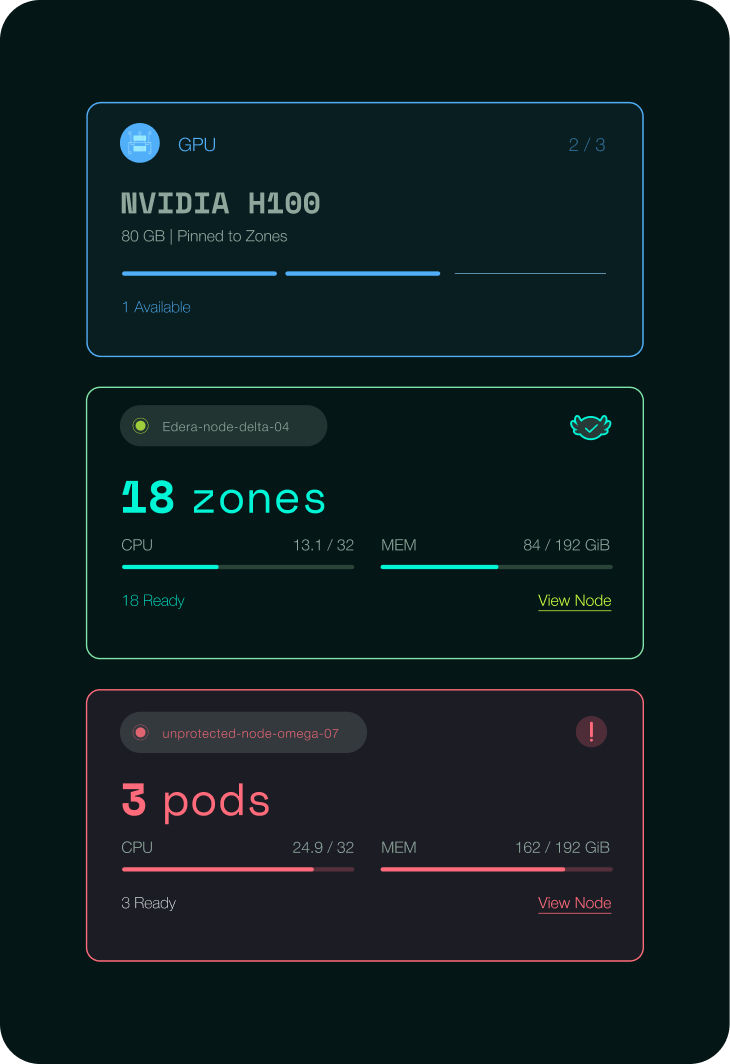
Edera Hardened Runtime puts a true hardware-isolation boundary around every pod and runs each one in its own microVM with its own Linux kernel, called a zone. With no shared kernel to escape, each workload is contained in hardware rather than software policy that has to be configured for every workload.
Install as a RuntimeClass
Deploy Edera and point your workloads at it with a standard Kubernetes runtimeclass. No control-plane, node, OS, or app changes.
Each Pod Gets a Zone
Every pod boots into its own microVM with a dedicated Linux kernel, isolated at the hardware boundary from the host and from every other pod.
Your Images Run As-Is
Because each zone runs a complete Linux kernel, your existing container images, syscalls, and tooling just work, no WebAssembly, no rebuilds, no surprises.
Operate it Like Any Pod
Zones schedule, autoscale, and report metrics like normal pods. kubectl top, HPA, and your dashboards all work at performance within 5% of native.
.png)

Early Access
Edera KVM early access is open now: try it on your own stack and help shape what GA looks like.
Core Features
Why Edera Is Different
A Kernel Per Pod

Native Container Speed
Drop-In for Any Kubernetes
Bring Your Own Cloud
Per-Zone Kernels for GPUs
Full Native Observability
DEEP DIVE
Where Edera Sits In Your Stack
.png)
.png)
Secure Infra, Lower Costs
Single-tenant burns budget on idle capacity; multi-tenant shares a kernel with real containment gaps. Edera gives every workload its own lightweight VM – one Fortune 500 cut footprint 62%, saving millions.
Ship Agents, Capture Return
90% of agent pilots stall in review – there's no mechanism to contain what an autonomous agent might do. Edera's hardware-isolated VM per agent makes containment real, so agents ship and revenue lands.
Remove the Risk
Minimal images and eBPF monitoring help reduce the attack surface, but containers still share one kernel – a bug can cross that boundary. Edera gives every workload its own kernel, removing the risk entirely.
.svg)
Try One Node of Edera Today
You're running untrusted workloads on infrastructure built to share everything. Every AI agent, every model execution, and every third-party container is a shared kernel away from your host. Edera closes that gap–without the compatibility limitations, overhead, or hardware dependencies of existing alternatives.
USE CASES
Built For Your Untrusted Workloads
AI Agent Sandboxing

Multi-Tenant Platforms
Untrusted Code Execution
GPU Workload Isolation
Compliance
Confidential Computing
Resources
A Curated Collection of Musings & Research
Catch Edera live on the show floor or online – same hardened-runtime talk, your choice of venue.
Real breaches, real research, real talk – we break down what's actually threatening your workloads and how to CYA before it's a headline.
Your home for everything from how-to guides and deep-dive technical overviews to configuration tips and troubleshooting workflows.

YOU KNOW YOU WANNA