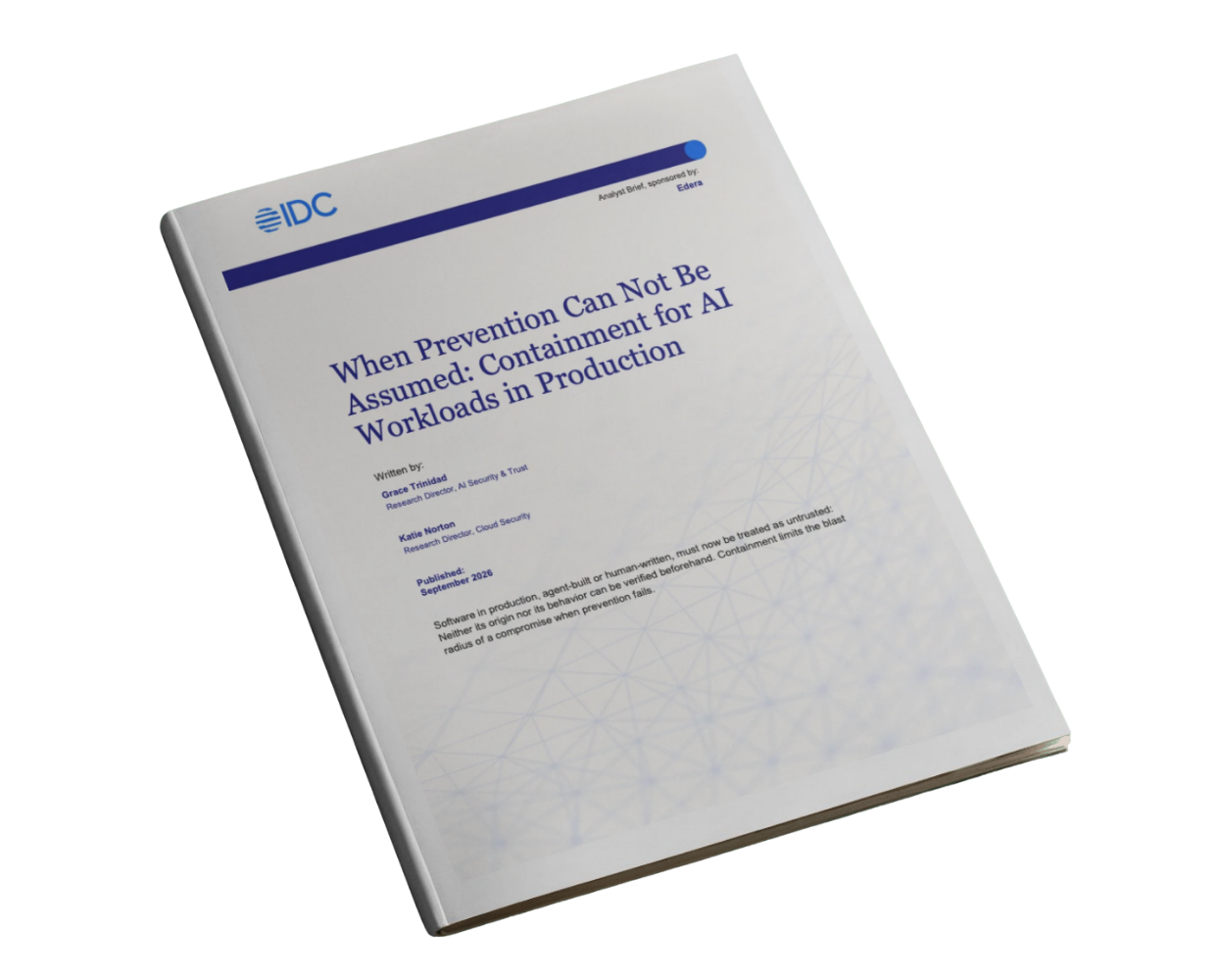
Prevention Can't Keep Pace. Containment Can.
A new IDC analyst brief on why bounding a breach's blast radius—not preventing every one—is the control that decides whether a compromise becomes an incident or a headline.
Analyst Brief
Prevention Can No Longer Keep Pace With Code You Didn't Write
Code now arrives from AI agents, coding assistants, open source, and third parties faster than any review can vouch for it. When what runs in production can't be assumed trustworthy, the question shifts from how to prevent a compromise to how to bound one.
In this IDC analyst brief, analysts Grace Trinidad and Katie Norton explain why containment—limiting the blast radius when prevention fails—has become the control for agentic AI, and what an isolation boundary has to do to earn that trust.

Analyst Brief
Contain the Breach Instead of Chasing Every One
Agentic AI has moved from pilot to production with 72% of enterprises running agents live, but the controls protecting them still assume a compromise can be prevented before it happens. That assumption no longer holds. This IDC analyst brief, by analysts Grace Trinidad and Katie Norton, makes the case that prevention can't keep pace with code arriving at machine speed, and that bounding a breach's blast radius has become the control that decides whether a compromise stays contained or becomes material.
Inside:
- Why AI-assisted vulnerability discovery has changed the game for CVE prevention.
- Deep analysis of the autonomous agent intrusion, and how containment prevented a large scale catastrophe.
- Why a shared kernel isn’t enough security for AI agents, and what running each workload on its own kernel actually requires.
- The GPU isolation gap: why accelerator isolation lags years behind the host, and the question to ask of any containment approach.
- Why blast radius reduction is a gating requirement for your next wave of agent deployments.
Frequently Asked Questions
Prevention depends on lead time—the gap between when a vulnerability is found and when it can be exploited. AI-assisted discovery is compressing that gap, pushing 2026 toward roughly 66,000 disclosed CVEs while remediation capacity stays flat (IDC). Agents also generate and run new code faster than any human release cycle can review it, so a growing share of what executes is never examined by the tools meant to catch it.
Prevention tries to stop a compromise before it happens. Containment assumes one will and limits how far it can reach. It caps the blast radius of a breach at a single workload instead of the whole host or cluster, so a failure stays an incident rather than a catastrophe—and it doesn't depend on anyone noticing in time to react.
No. Every standard container on a host shares the same kernel, so one compromised container can reach other workloads or the host itself. Real containment requires each workload to run on a kernel of its own rather than one borrowed from a shared host. The whitepaper details why the isolation boundary, not detection, becomes the entire security model once behavioral guardrails are absent or defeated.
Additional Resources
A Curated Collection of Musings & Research

Thinking Outside the Sandbox: Every workload is untrusted, start building like it.

What IDC New Analyst Brief Says About Containment for Agentic AI

See what a blast radius of one looks like in practice: Test one node of Edera today

YOU KNOW YOU WANNA
Talk to an Expert
Running AI agents, third-party code, or multi-tenant workloads in production? Let's map where your isolation boundary holds—and where a single kernel bug crosses it.